
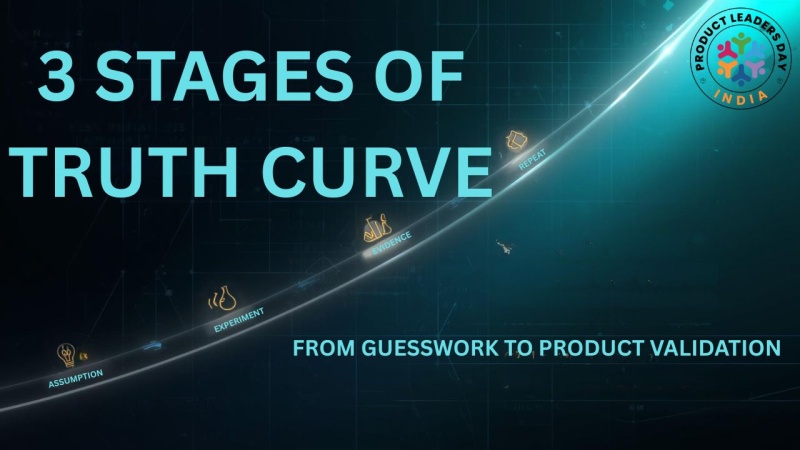
Every product starts with a belief, a spark of intuition about what people might want. But intuition alone doesn't pay the bills; validation does. The best product teams in the world, at companies like Airbnb, Netflix, and Notion, don't just rely on ideas. They turn beliefs into experiments and experiments into evidence.
This journey is what we call "The Truth Curve". Let's explore the three stages of truth that every product, idea, or startup must pass through, from assumption to validation.
The article was published on Product Leaders Day India
Stage 1: Assumptions – The Land of Beliefs and Guesses
Every idea begins with an assumption, a guess about what customers want, how they behave, or what they value. At this stage, everything feels exciting, but also fragile. You're basically saying:
- "We believe users will pay for this feature."
- "We think our AI chatbot will save people time."
The problem is that beliefs feel true because they sound logical. But until they're tested, they're just stories.
A Warning from History: Think of Nokia in the 2000s. They assumed people wanted durable phones, not touchscreens. That single assumption cost them their global dominance.
It’s like guessing a recipe without tasting it; you think it’ll be great until the first bite.
Your Goal in this Stage: List your assumptions clearly. Don’t hide behind confidence. Write them down. Tools like Miro, Notion, or AI-powered whiteboards (e.g., FigJam AI) can help you visualize and cluster them.
Stage 2: Experiments – The Bridge Between Belief and Evidence
Once you’ve identified your assumptions, it’s time to test them fast and cheap. This is where experiments come in: simple, controlled tests that help you learn what’s true.
Common Product Experiments:
- Landing Page Tests: Create a mock page and see how many visitors click “Sign Up.”
- Concierge MVP: Offer a manual version of your product to test real demand.
- A/B Tests: Compare two versions of a feature or message.
- Fake Door Test: Add a button for a feature that doesn’t exist yet — see if users click.
Case in Point (Dropbox): When Dropbox launched, they didn’t build the whole product. They created a 90-second explainer video showing how Dropbox would work, and thousands joined the waitlist overnight. That was an experiment, and it proved real demand.
AI-Driven Experimentation: Cheaper and Smarter Testing
Many product teams now use AI-driven simulation tools like Amplitude Experiment, Optimizely AI, or Google Optimize (integrated with Gemini/Vertex AI) to predict and analyze test outcomes faster. This makes experimentation not just cheaper, but smarter.
Your Goal in this Stage: Run small, safe-to-fail experiments that bring you closer to truth. You’re no longer guessing; you’re learning.
Stage 3: Evidence – The Land of Clarity and Confidence
This is where magic happens. You now have data, user feedback, and measurable proof that either validates or disproves your idea. Evidence gives you the confidence to move forward, or pivot with purpose.
The Instagram Pivot: When Instagram first started, it wasn’t about photos; it was a location-sharing app called Burbn. But early data showed users loved the photo-posting feature the most. That insight became the evidence to pivot, and the rest is history.
It’s like a pilot checking their instruments mid-flight; they don’t fly on instinct, they fly on data.
AI Insight: Generative AI tools are now helping teams analyze qualitative data, from survey responses to user interviews, at scale. Platforms like Dovetail AI, Notably, and ChatGPT (via custom GPTs) summarize learnings, find patterns, and generate insights, turning messy feedback into solid evidence.
Your Goal in this Stage: Use evidence to prioritize what works and kill what doesn’t. Products thrive not because teams are smart, but because they’re scientifically humble.
Real-World Example: Airbnb’s Journey Up the Truth Curve
This famous case illustrates the three stages perfectly:
- Assumption: People would rent their homes to strangers.
- Experiment: A simple website with a few listings and basic payment flow.
- Evidence: When conference visitors booked real stays, validation arrived—the crazy idea worked.
Today, Airbnb continues to use experiments, A/B testing, and AI-driven personalization to stay ahead. They didn’t just guess their way to success; they tested their way there.
The Big Takeaway: Continuous Discovery & The Truth Curve
The truth isn’t found overnight; it’s earned through small, repeatable cycles of learning. This cyclical process is what modern product management calls Continuous Discovery.
Stage: Assumptions
Focus: Beliefs & hypotheses
Mindset: "We think..."
Stage: Experiments
Focus: Validation tests
Mindset: "Let's try..."
Stage: Evidence
Focus: Data-driven insights
Mindset: "We know"
In today’s AI-powered, fast-moving product world, those who climb the truth curve faster win.
Closing Thoughts
In a world overflowing with opinions, truth is your ultimate competitive advantage. Great product leaders don’t just launch features; they discover truths about their users, market, and value.
So next time you pitch an idea, ask yourself: “Where am I on the Truth Curve: belief, test, or proof?”
Because in modern product management, truth isn’t found in the boardroom, it’s discovered in the experiment room.
The article was published on Product Leaders Day India